Counting Drinks With a Camera: A Fair, Legal Setup Guide for Bar Owners
How to use a camera to count drinks at your bar in a way that is fair to staff and meets notice rules in Ontario, Connecticut, New York and elsewhere.
The short answer: you can usually use a camera to count drinks behind your bar, but you should tell your staff before you start, explain exactly what it measures and why, keep the camera on the bar and off private areas, and in some places put it in a written policy or a posted notice. Done this way, counting tends to protect good bartenders rather than threaten them.
This article is general information, not legal advice. Rules differ by province, state and country and change often. Check with an employment lawyer where you operate.
Key takeaways
Be open about it. Secret monitoring is where most legal and morale problems start.
Ontario employers with 25 or more employees need a written electronic monitoring policy and must give staff a copy.
Connecticut's updated law, in force since 1 October 2026, requires written notice of camera monitoring that names the locations, posted where monitoring happens.
Point the camera at the bar and the bottles, not at faces, the till drawer or anywhere private. Leave audio off.
Use the counts to coach and to fix systems, not to ambush people.
Why bars are putting cameras on the pour
Most bars already have security cameras. They are good at answering "what happened at 11:42 on Saturday?" after something goes wrong, and almost useless for answering "how many drinks did we pour last night?". Nobody has time to watch eight hours of footage per shift.
That second question matters because most beverage loss is invisible to the POS. Over-pours, free drinks for friends and unrecorded spills never show up in sales data. They only surface weeks later as inventory variance, by which point nobody remembers which night it was. (If you have not calculated your variance yet, our guide to bar inventory variance walks through it.)
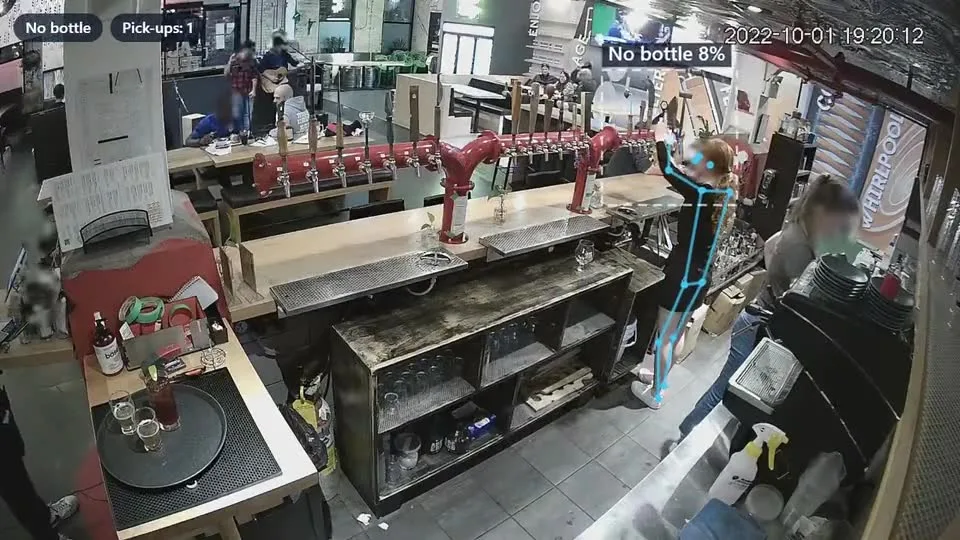
Camera-based drink counting closes that gap. Software watches the bar and counts events, such as a bottle being picked up or a pour being made, and gives you a number per shift that you can line up against what was rung in. A shift with 180 pours and 150 rung drinks gives you something specific to look at. A shift where they match gives you confidence, and gives your bartenders a record that backs them up.
What a counting camera does and does not need to see
A counting system has a narrow job, and the setup should match it:
It needs a clear view of the bar top, the well and the back bar where bottles are picked up and poured.
It does not need faces, guests at the bar, the till drawer, the cash count, staff areas or anything outside the service area.
It does not need audio. Recording conversations can bring in interception and wiretap laws that do not apply to video, and it adds nothing to counting.
It does not need to store hours of footage. A count can be kept without keeping the video it came from.
The less a system sees and keeps, the easier it is to justify to staff and to any regulator, and the less there is to protect.
What the law asks: some examples
Laws on workplace monitoring fall broadly into three groups: rules that you tell employees, rules on where you may not monitor, and privacy laws on how you handle what you collect. Here is how that plays out in places many BevCounter customers operate.
Ontario: a written electronic monitoring policy
Since 2022, Ontario's Employment Standards Act has required employers with 25 or more employees in Ontario on 1 January of a year to have a written policy on electronic monitoring in place before 1 March of that year (Osler). The count includes everyone employed in Ontario, across all locations, including part-time staff.
The policy must say:
Whether the employer monitors employees electronically.
If so, how and in what circumstances, and the purposes for which the information may be used.
The date the policy was prepared and the date of any changes.
Employers must give every employee a copy within 30 days of the deadline, and a copy of any revised version within 30 days of the change. The rule is about transparency: it does not itself create a new privacy right or limit how the employer may use the information (Osler; Blakes). A smaller bar is not required to have one, but writing one anyway costs little and answers most staff questions.
Connecticut: notice that names the locations
Connecticut has required employers to give prior written notice of electronic monitoring for years, and its definition expressly includes cameras. Public Act 26-73, which took effect on 1 October 2026, tightened it: the notice must now say the types of monitoring and the specific locations where it may happen, and the posted notice must also appear at those locations. Employees hired from that date must get a plain-language written statement before they start. Civil penalties run from $500 for a first violation up to $3,000 for a third or later one (Workplace Privacy Report).
For a bar, that means a notice in the staff area and one at the bar itself, saying a camera counts drinks there.
New York: notice for communications monitoring
New York's Civil Rights Law §52-c, in effect since May 2022, requires private employers that monitor employees' phone, email or internet use to give written notice on hiring, get an acknowledgement, and post the notice (Morrison Foerster). It is written around communications, not cameras, so it may not apply to a counting camera at all. Giving the same style of written notice for a counting camera is still simple, and it avoids arguments later.
Elsewhere
Other Canadian provinces. Quebec, British Columbia and Alberta have private-sector privacy laws that cover employee information, so collecting video of staff needs a reasonable purpose and notice there.
UK and EU. Identifiable video of a person is personal data under the GDPR. You need a lawful basis, must tell staff, should limit what is captured and kept, and staff can ask to see recordings of themselves.
Almost everywhere. Cameras in washrooms, change rooms and similar private spaces are off-limits, and hidden cameras are far harder to justify than visible ones.
Six principles for a fair setup
Whatever the law requires where you are, these principles keep a counting camera on the right side of both the rules and your team.
Purpose, written down. "To count drinks poured and compare them with drinks sold, so we can control pour cost." One sentence that everyone can read. Do not quietly widen it later.
Tell people first. Staff hear about it from you, before it is switched on, not from a sticker they notice on a Friday night.
See only what you need. Frame the bar and the bottles. Keep faces, guests, the till and staff areas out of shot. No audio.
Keep as little as possible. Keep counts; keep footage only as long as you need it, and only if you need it at all. Decide who can see it.
Patterns, not single moments. One odd shift means little. A pattern over weeks is worth a conversation. Look at systems (jiggers, waste logs, comp rules) before people.
Fair use of results. Use counts to coach, to fix process and to back up staff when numbers are questioned. If a count ever leads to discipline, follow the same process you would for any other evidence, and let the person respond.
What to put in your policy
If you need a written policy (Ontario at 25+ employees), or simply want one, a single page is enough. Cover:
What is monitored: "A camera above the main bar counts bottle pick-ups and pours during service."
Where: the exact locations, such as the main bar and service bar. (Connecticut now requires the locations.)
How it works: what the software records (counts per shift; footage or not, and for how long).
Why: the purpose from principle 1.
Who sees it: for example, the owner and the general manager.
How results are used: coaching, inventory control, and, after a fair process, discipline where there is clear evidence.
What is never monitored: washrooms, staff room, audio.
Questions: who staff can ask.
Dates: when the policy was written and last changed.
Post a short notice at the bar and in the staff area: "A camera at this bar counts drinks poured during service. Ask a manager for the monitoring policy."
How to tell your staff
The introduction matters as much as the policy. Bartenders who hear "we are putting a camera on you" will assume the worst. Bartenders who hear the reason and the limits usually do not mind, and good ones often welcome it. A short pre-shift talk works:
"Our pour cost has been running high and we can't tell where it's going. We're adding a counter at the bar that counts pours, so we can compare them with what's rung in. It doesn't record sound and it's pointed at the bottles, not at you or the guests. If numbers ever don't match, we'll look at the system first: jiggers, comps, the waste log. And if anyone ever questions your shift, the count backs you up. The policy is on the staff board, and you can ask me anything."
Then do what you said. The first time a count is used to defend a bartender, for example when a regular claims they were short-poured, trust goes up.
How BevCounter is built for this
We built BevCounter around these principles. It turns a laptop or phone you already have into a drink counter: point the camera at the bar and it counts bottle pick-ups and pours during service. The counting runs in your browser on that device, rather than on an AI server, and the result you work with is a count per shift that you compare with your POS. Plans start at $29 a month, or half that paid yearly.
You still need to tell your staff, frame the camera sensibly and follow your local rules. But you start from a tool designed to count drinks, not to watch people.
Checklist before you switch it on
Purpose written in one sentence
Camera framed on the bar and bottles only; audio off
Written policy (required in Ontario at 25+ employees; good practice everywhere)
Notice posted in the staff area and at each monitored bar (required in Connecticut)
Staff told in person before go-live; questions answered
Retention decided: counts kept, footage kept for how long, if at all
Access decided: who can see counts and any footage
Local legal advice taken if you are unsure
FAQ
Do I need staff consent to use a camera behind the bar? Generally, notice rather than consent is what the rules require, and a visible, disclosed camera in a work area is widely accepted. Some places and some union agreements ask for more. Check locally.
Can I use the camera to discipline someone? Often yes, if staff were told how results may be used and you follow a fair process. In Ontario the policy must state the purposes the information may be used for.
Can I use my existing security cameras? You can point a counter at the same area, but your notice and policy should cover the new purpose. Security footage collected for one reason should not quietly be reused for another.
Should guests be told? A camera that frames only the bar top and bottles captures little of guests, but many bars already post a general "cameras in use" sign. It is good practice and required in some places.
What about a hidden camera? Avoid it. Hidden monitoring is far harder to justify, can break notice laws, and destroys trust if it is found.
Sources
Osler, Ontario's electronic monitoring policy requirements now in effect
Workplace Privacy Report, Deadline imminent for Connecticut's expanded electronic monitoring law
Morrison Foerster, New York enacts employee monitoring notification law
AI and Ethics (Springer, 2025), on computer vision surveillance in the workplace